Norse runes: symbols as a mirror of the soul
Norse runes aren't just ancient signs. They can work as mirrors for choice, courage and fate. In tarot, The High Priestess holds the same kind of listening.
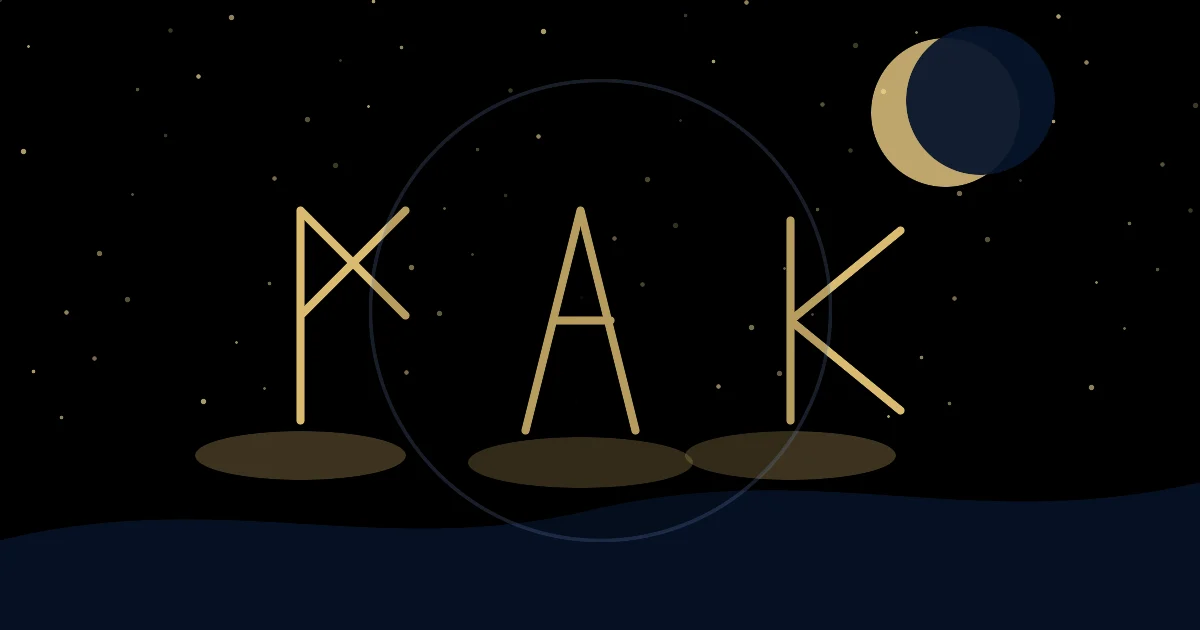
Norse runes are ancient symbols linked to sound, mystery, memory and guidance. As a spiritual mirror, they don't exist to take away your freedom, but to reveal a question that was already alive inside you. In tarot, The High Priestess speaks to that same silent listening.
Today's page
Today I woke up thinking about small symbols that carry an entire world. An old letter carved into a stone, a mark on a piece of wood, a sign that looks simple until you sit with it long enough. Norse runes carry that kind of presence. They come from ancient Germanic and Scandinavian peoples, linked to sound, fate, memory, protection and mystery. But I don't want to talk about them as a museum curiosity. I want to talk about them like a page from the witch's diary: when a symbol looks back at you, something inside you starts confessing its own truth.
What runes are
Runes formed ancient alphabets used by peoples of northern Europe, such as the Elder Futhark. Each sign carried a sound value and also a symbolic charge. Fehu speaks of resources and circulation. Uruz recalls vital strength. Ansuz touches on the word and inspiration. Raidho speaks of the path. Isa speaks of ice, pause, containment. There's no need to romanticise them or turn everything into prediction. The most beautiful thing about runes is realising that a symbol can open a question, and a well-formed question can change the direction of a life.
The High Priestess as mirror
In tarot, The High Priestess sits before the veil. She doesn't hand everything over at once. She teaches that some knowledge arrives in silence, in layers, through feeling, through repetition. Runes speak with that same quality. They don't shout an answer. They place a sign on the table and ask: what does this awaken in you. When an ancient symbol works, it doesn't steal your choice. It returns you to the part of yourself that already knew, but didn't yet have the words.
A symbol isn't a sentence
I need to write this firmly, because a lot of people turn to oracles when they're afraid. A rune shouldn't become a prison. A card shouldn't become a threat. A spiritual symbol doesn't exist to hold you hostage to one interpretation. It exists to open awareness. If you draw a rune of pause, that doesn't mean everything is over. It might mean movement is frozen for now, or that forcing things right now would break something delicate. The symbol guides, but you're the one living the life.
The word that creates the world
One thing I love about runes is that they remind us writing, sound and world were once felt as parts of the same magic. Naming something changes how we relate to it. When you call a delay a failure, the body tightens. When you call it a pause, it might breathe a little. When you call desire neediness, you judge yourself. When you call it a need for connection, you can care for it better. Ansuz, linked to the word and to inspiration, reminds me of this: talking to yourself is also a ritual. The way you name your own phase can open or close a path.
Fate isn't a chain
Ancient peoples spoke of fate with respect, but that doesn't have to become fatalism. There's the thread we're given, there's the knot that appears, and there's the way we hold that thread in our hand. A rune might point to a tendency, a tension, a protection or a warning, but it doesn't erase your part in it. I distrust any spirituality that turns a person into a spectator of her own life. A good symbol calls you back to responsibility, not to passivity. If something is written in stone, there's still the way you walk around it, sit on it, learn from it, or decide not to carry that weight any longer.
Receiving without obeying
Receiving a symbol with maturity is different from obeying it blindly. You can listen to a rune, a card, a dream, a coincidence, and still bring everything back to the body, to reality and to time. Ask yourself: does this make me feel more whole or more afraid. Does it call me toward a possible action, or trap me in an endless waiting. The sacred doesn't need panic to be taken seriously. When the message is good, even when it hurts, it usually brings a kind of steady inner quiet.
When the symbol pokes at you
Sometimes a symbol appears and it stings. Fehu might poke at your relationship with money and worth. Isa might show you where you're stuck. Algiz might speak of protection, but also ask whether what you're calling protection is actually fear. Ansuz might spark a conversation that needs to happen. That's the difficult beauty of a symbolic oracle: it doesn't just come to confirm what we want to hear. It shows the question the soul has been trying to avoid.
The difference between intuition and anxiety
When anxiety grabs hold of a symbol, it wants to turn everything into immediate certainty. It asks ten times, seeks one more confirmation, switches oracles, consults someone else, reinterprets until it gets the answer it wanted. Intuition is different. It can be strong, but it isn't frantic. It lets a meaning settle. If a rune has brought you clarity, notice whether you feel more present or more compulsive. True clarity usually brings groundedness, even when the answer isn't easy.
A practice with symbols
Choose a word that's alive in you right now: love, money, courage, waiting, boundaries, forgiveness, path. Then choose a simple symbol to represent that word. You could draw a line, a circle, a tree, a stone, a star. Put it on paper and write around it: what does this symbol show me, what doesn't it promise, what small action does it ask of me today. This practice doesn't need an elaborate ritual. It just needs honest presence.
Closing the grimoire
Norse runes remind me that the world speaks in signs, but the soul needs to learn to listen without losing itself. The High Priestess, seated in silence, knows that not every mystery needs to be forced open. Some reveal themselves once the question has matured. If a symbol keeps repeating itself in your life, a personalised reading might help you separate message, fear and desire. Not to close off the future, but to look in the mirror with more calm. Today, hold on to this: the symbol points the way, but you're the one who walks through the door.
Frequently asked questions
What are Norse runes?
They're symbols from ancient Germanic and Scandinavian alphabets, used as writing and also associated with spiritual meanings — memory, protection, path and strength.
Do runes predict the future?
They can be used as a symbolic tool for reflection, but shouldn't be treated as a fixed sentence. A symbol guides the question; it doesn't replace choice, care or responsibility.
Which tarot card pairs well with runes?
The High Priestess pairs well with runes because she speaks of mystery, silence, inner listening and knowledge that reveals itself in layers.
A card's meaning shifts with the question, position and context. No single card should be read as a verdict on its own.